

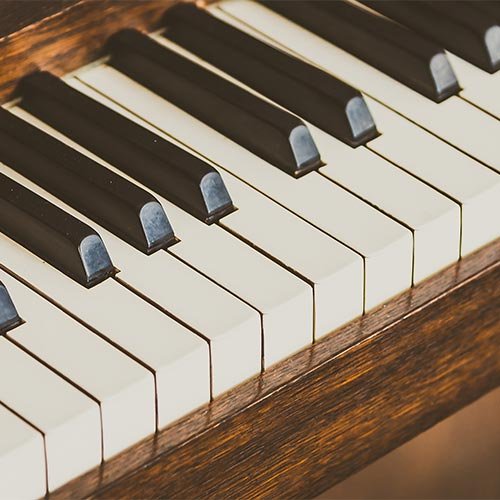
After years of playing the piano and going through many hardships, I owe my success to my teaching approach. Beginning pianists may get lost in the multitude of teaching methods, books, and techniques. Starting is important, but how to start is also important. In this article, I will express the result of years of experience and trial and error in the form of 15 important points, by following which you will at least be sure that you are walking in the right direction.
1- Get a good teacher
Many beginners like to learn piano by themselves. Thanks to the internet, YouTube and free resources, you can find the answer to any question. You can learn whenever, wherever, whatever you like. But there is a problem in the middle. Self-taught people may make mistakes over and over again; Without their knowledge. For example, after months of practice, they realize that they used a wrong method of fingerprinting. These mistakes become bad habits and it can take time to get rid of them.
A good teacher will monitor your playing and help you whenever he sees a problem. YouTube videos barely talk about fingering and tempo; And basically these things cannot be explained by video or book. Take your time and research and consult to find a good teacher. Even if you want to learn by yourself, it is still better to be under the supervision of a teacher for the first few days.
2- Play your favorite songs
There are many pieces for piano; So much so that if you spend your whole life playing them, they will not be finished. Many beginners get involved in learning parts that they have no interest in. Of course, sometimes this is done to improve listening skills, or to participate in competitions, or to show the skill level; But in general, there is no need to spend a lot of time learning something you have no interest in.
Because when you are not interested, there is no proper coordination between the mind and the muscles and therefore you cannot get the details of the song well. I suggest you practice a combination of classical, pop, etc. songs. In some cases, you may turn a bad song into a song that you like by making modifications. Do not miss the opportunity to practice different styles.
3- Don’t be too obsessed with techniques
As a beginner, I fully understand how difficult it is to choose a teaching method. We need technique, but playing the piano is more than playing steps and speed exercises. I suggest you learn the techniques described in these books as much as you can; But try not to spend too much time on this. For example, do all the exercises of Beer in one breath from the first page to the last. During the exercises, practice your favorite songs to change your mood. Some techniques must be violated in certain situations; So be flexible and don’t resist new ways. Break the hard pieces into smaller pieces. For example, if there are 16 notes in a measure, divide it into 4 notes and break the chords into their constituent notes.
4- Perform for others as much as you can
This view that because you are new you should not perform for others is wrong. You can even perform in front of your friends or family with a C Major chord! I suggest you use every opportunity to perform for others. This will give you confidence. Telegram, Instagram, Twitter and many social networks are a good environment for performing music. When others give their opinions about the piece you played, it gives you a good feeling; And you may even find friends who will explain your problems from a technical point of view.
5- Break large amounts into smaller units
Breaking down complex measures into smaller units helps you gain a better understanding of the piece’s structure. The presence of many notes in a measure may confuse beginners. In such a situation, use the technique of simplifying the problem. Break the scale into different groups of notes and examine each group separately.
6- Listen to a lot of music
Some of my teachers encouraged me not to listen to the pieces of other pianists; Because they didn’t want me to copy what I heard. I disagree with this view and even believe that this work has many benefits for beginners. By listening to the song, you get a better understanding of the dynamics, articulation and their application in the actual performance. These things can hardly be understood from the notes of the song.
7- Practice at low speed
Speed sings the victory of playing. Sometimes in a piece, there are parts that you must slow down to perform properly. Practicing at low speed is a great technique for precise execution. This technique will help you not to make mistakes due to playing fast.
Early on, I spent a lot of time playing fast; But later, I noticed a lot of problems with my performance; For example, I was hitting the wrong rhythms, I didn’t have much control over the dynamics, etc. That’s why I put slow training on top of my work. This approach made me not to make previous mistakes. I no longer had to practice anything to extremes. At first, I played the scales at a low speed and gradually increased the speed. Even now, when I see that a piece of work is lagging, I go back and run it at a slow speed.
8- Buy a good piano
Maybe this point is not to your liking, but as an experienced pianist, I know the necessity of using a proper piano. During the years of teaching, I know that the weakness of many of my students is not in practice, but in compromises. At first, I thought that the problem was due to their practice, but later, through conversation and research, I realized that the problem is due to the use of low-quality keyboards and pianos.
Keyboard is cheap and you can own a keyboard instrument for a low amount. But the problem with most keyboards is that the mechanism of hitting their keys is not the same as that of a piano, and later you will have problems when you practice with the piano. The musician spends many hours practicing the keyboard at home, but he has problems with the piano in class; Because piano keys are heavier and require more pressure. In other words, such a state is called: the hands are keyboarded. A keyboard is not bad to start with, but if your goal is to play the piano, you shouldn’t use it forever. After a while, when you have learned the basics of music and playing, use a real piano instead of a keyboard.
9- Learn music theory
As I progressed, my playing got better and better; But I still did not know music theory. To be honest, I didn’t think music theory was important in playing; But now that 20 years have passed, I regret why I didn’t start sooner.
Theory helps you understand the principles behind music. Knowing the basics of music will help you recognize the basic structure of a song. Understand the chords and know exactly what is going on. This is especially important for beginner pianists; Because sooner or later they have to understand the main keys, changing signs and many other important topics. Fortunately, there are many educational resources for learning music theory. Even basic information published on Wikipedia can work.
10- Save the piece
Note reading is important, but no matter how professional you are, you may slow down in some parts. Try to memorize the song. Only by doing this, you can perform the piece with the right dynamics, correct finger placement and dramatic movements. You connect with a song when you can memorize it. Music is an internal thing and the more you record it in your mind, the better you will perform. I suggest you listen to the song over and over again before starting to play it so you can master all the details.
11- Don’t forget to read notes
Reading notes is as important as memorizing the song. In learning new pieces, you will probably need to read sheet music many times. Recognizing rhythms, notes, and major keys will help you play music faster. Without having this skill, the speed of learning will decrease drastically and you may even spend weeks to understand the structure of a song and still not succeed. But for someone who has strengthened this skill, only 5 to 10 minutes of music reading is enough.

12- Have a good posture
The way you sit behind the piano is a very important issue that even if I ignore its effect on playing the piano, it should be given special attention because it affects your health. For example, you should not bend your back while sitting. The hand should be at a 90 degree angle with the piano keys. Ignoring this issue will lead to the formation of a series of bad habits that will be difficult to correct in the future. In the picture below, you can see the best way to sit behind the piano. Sit in the front half of the bench. Bend the knees slightly under the piano and place the soles of the feet on the floor. The head should be vertically aligned with the spine and your back should be straight. The elbow is slightly above the keyboard.
Your Comment